As a Xennial, I was a very early adopter of social media. First Diaryland, then MySpace, and then Facebook had me all-in and extremely online. That’s when, in November of 2014, Facebook, with its hooks deep in my dysregulated dopamine pathways, fed me my first video of a child being murdered.
After the flood of misinformation that followed the killing of Tamir Rice, with posts justifying his death and vilifying Black Lives Matter, I gave up on Facebook (and humanity, a little). This was a watershed moment that opened my eyes to how social media can impact our information landscape and mental wellbeing.
Since then, the dialogue about misinformation and social media has continued to evolve, often influenced by political and corporate interests. The platforms have taken a variety of different approaches to curbing misinformation.
For this post, I’m going to evaluate the effectiveness of the methods used by both Pinterest and Reddit, because they are platforms that I use frequently. I will also address some of the deeper issues I believe are underlying the spread of misinformation that cannot be solved at by the platforms themselves.
Pinterest has some social aspects, but it’s more of a visual search engine. It’s a great place to go if you want to see mostly inoffensive, wholesome content. In fact, they explicitly ban most kinds of adult content. Pinterest’s guidelines specifically address (and ban) health, civic and climate misinformation. Like many platforms, they use automated tools for the majority of content moderation, like using AI to detect misleading content as it is uploaded, and tracking suspicious behavior patterns to flag problematic accounts. They do have human teams who review edge cases, and handle escalated safety issues.
Enforcement actions include anything from deactivating a single pin to removing accounts. Pinterest holds itself accountable by preparing biannual transparency reports. For example, their report from 2023 notes, “In Q2 2023, we deactivated 874,125 distinct images, which comprised 47,644,063 Pins, for violating this policy. Of these Pins, 94% were seen by fewer than 10 users in this reporting period. We deactivated fewer than 1% manually and more than 99% with hybrid tools.”
Pinterest makes moderation a little easier by banning lots of content that is allowed on other platforms, but unfortunately that still leaves a lot of room for misinformation. As someone with loved ones struggling with chronic illness, health misinformation is of particular concern to me. In fact, it fills me with rage, and it seems as though Pinterest isn’t doing that great at limiting it.
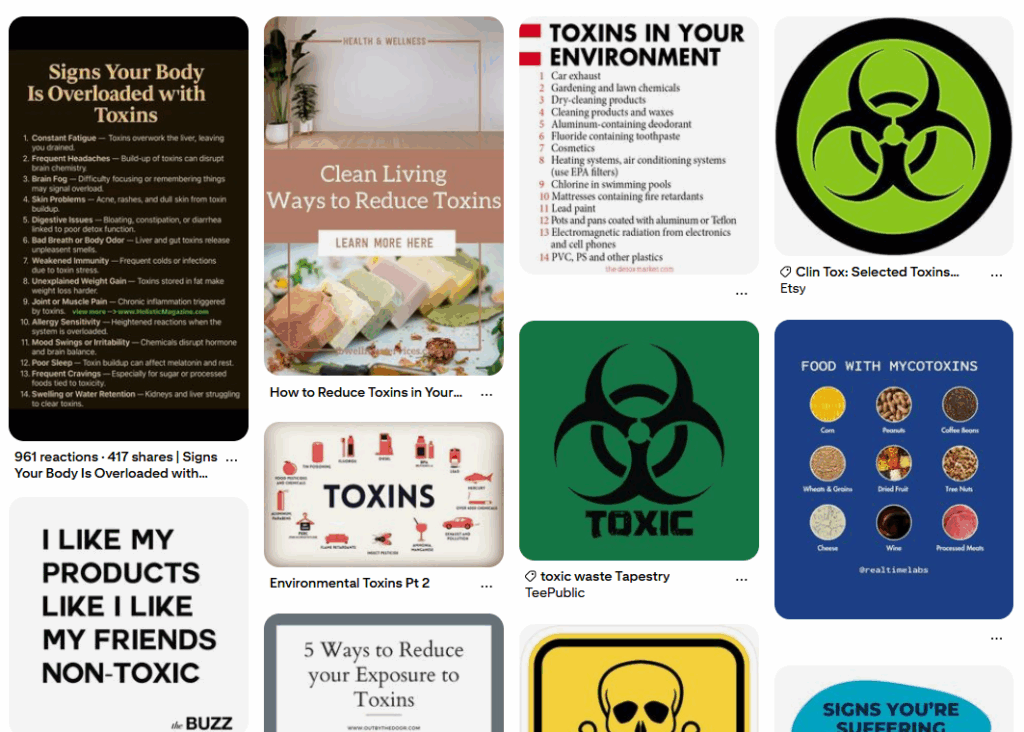
One study found that almost half of pins related to breast cancer contained misinformation. I did a simple search for the word “toxin” (a common fear-inducing tool in health misinformation) and it resulted in many questionable pins labeling things like toothpaste and cosmetics as toxins, and claiming they are the cause of a variety of health issues. Part of the problem is that Pinterest shows images that link other websites, so a pin can look compliant, while linking to harmful content. I think Pinterest still has work to do.
Reddit takes an entirely different approach to content and content moderation. Founded on principles of free speech (sort of) and community, Reddit has changed over the years as it has become more beholden to corporate interests, but not a lot is explicitly banned. The community-based platform outlines eight rules that govern the platform, and allows the individual communities to create their own rules as well. Rules violations can result in anything from a polite request to stop to outright banning of entire communities (subreddits).
Reddit is primarily moderated by automated systems as well, but community moderators, who volunteer their time, take on a lot of the burden of content moderation. This method can be very effective depending on the community and the culture of the community.
For example, in the Ask Docs subreddit (a community of medical professionals who take questions from laypersons), moderators vet community members individually, by verifying licenses, and only licensed medical professionals are allowed to make top-level comments on posts, other comments are deleted immediately. Professionals credentials are automatically tagged on their comments using a moderation tool called “Flair”. Allowing communities to self-moderate generally makes sense and is effective. It allows for customization as needed. Sitewide credential verification to talk about health would be overboard, but in r/AskDocs, it makes sense. However, there are downsides to self-governance as well: Enforcement can be inconsistent, and unpaid moderators can get burned out.
When it comes to misinformation, Reddit’s rules say almost nothing. Misinformation falls under Reddit’s first rule, “Remember the human. Everyone has a right to use Reddit free of harassment, bullying, and threats of violence.”
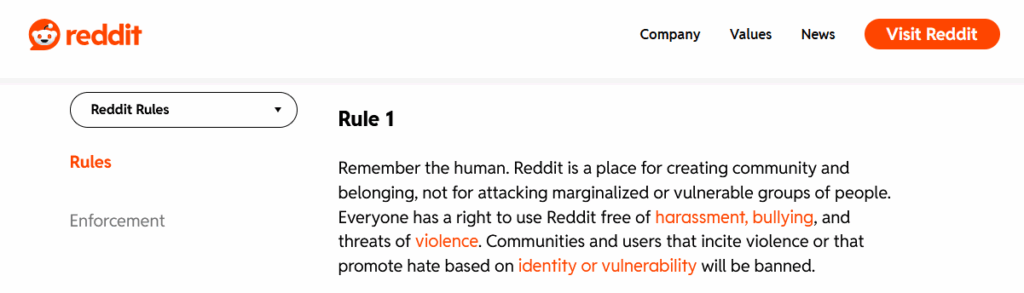
Reddit provides this clarification: “Note that health misinformation, namely falsifiable health information that encourages or poses a significant risk of physical harm to the reader, also violates the Rule.” This is the only mention of misinformation. Individual subreddits like r/science and r/AskHistorians have more strict guidelines. Reddit’s policy may seem a little lax, but in some ways it makes sense. In my own personal experience seeking health information, I’m glad that when I asked a question of health professionals, I knew that the users were vetted. On the other hand, when I was desperately seeking a personal treatment for allergies, I’m glad I was able to find the r/Allergies subreddit and a recommendation for a supplement that helped, but has not been scientifically validated enough to be recommended by doctors. The nature of subreddits as distinct communities automatically creates context for the information contained within.
Pinterest’s strict content rules and Reddit’s self-governance show different ways of tackling misinformation, and both still fall short. Misinformation is rampant on both platforms, and there are other content moderation problems as well, like addressing AI and cybersecurity.
We often talk about platforms as if they have distinct personalities and identities. X (formerly Twitter) and Facebook have gotten a lot of negative attention lately, and for good reason, but platforms change and identities are not stable. Policies, moderation philosophies, leadership and even legal and business structures change. For example, Reddit began as a startup, was sold to Condé Nast in 2006, became a public benefit corporation in 2021, and went public in 2024. All of those changes had an impact on the platform. Bluesky, which started as a Twitter project to explore decentralizing social media, is the ad-free darling of left-leaning microbloggers who exited Twitter during Musk’s 2022 takeover. But Bluesky could change, and likely will.
We have got to stop anthropomorphizing businesses and platforms in this way. Historically, they often let us down (See: Target, Bud Light, Meta). It’s time to acknowledge that the normative corporate ideology in modern-day America is best summed up by Milton Friedman’s 1970 declaration that ‘the social responsibility of business is to increase its profits.’ We cannot count on businesses and platforms to do good. We can only count on them to do business. They will do good if it’s good for business.
Instead of bullying and shaming corporations, I propose regulation. Social media platforms should be required to contribute to an independently-operated fund that develops general and platform-specific media literacy and digital citizenship training. Each organization should integrate this training into their platform, allowing a low-friction way for users to become more media literate. Users could be incentivized with visible certifications and badges. Businesses could be incentivized to have certified employees.
Furthermore, we know that fake news spreads faster. But why? Because we don’t know it’s fake! I believe that if we give people the tools they need to recognize misinformation, we will be naturally disincentivizing it. No one wants to believe falsehoods or support bad actors, we do it because we don’t know any better, or we don’t recognize the harm. So let’s know better – by using tools like government regulation and collective action to force these platforms to implement harm-reduction tools like on-platform media literacy training. Meta’s read-before-sharing tool is a good start.
Platforms like Facebook, Reddit and X don’t just host content — they extract value from it: our content, our data, and our unpaid moderation. I call this triple exploitation. It’s a brilliant and evil plan that makes a few people rich, and the rest of us angry, misinformed and divided. We don’t have to give up on social media or capitalism to fix this issue. We simply have to acknowledge the reality of these systems and act accordingly. No platform can truly solve misinformation from the top down. Rules and moderation help, but only a media-literate user base can build the kind of immunity to misinformation that makes it unprofitable. Until platforms are required to fund that inoculation, their fixes will only be band-aids.
Featured Image: A Perch of Birds vintage illustration wall art print and poster design remix from original artwork of Hector Giacomelli