I’m an incredibly sensitive person, and I’ve led a pretty sheltered life in rural America. So, despite growing up obsessed with hip-hop culture, and listening to artists like Public Enemy and Tupac, I never truly understood the struggle these artists were expressing in their lyrics about police violence in America. For many of us in “White America,” the killing of Mike Brown and the start of the Black Lives Matter movement popped the bubble on the idealized notions we had about race in our country. Because it wasn’t just Mike Brown, it was Eric Garner, Tamir Rice, Freddie Gray, Philando Castile. Coming to the painful awareness of the extent of racial injustice and police brutality was only amplified when I learned, via Facebook posts and commentary, that a lot of the people in my life who I thought shared my values didn’t care, or worse.
Since then, I have had my heart broken over and over again, watching atrocities that humans commit against each other. Charleston, Las Vegas, Parkland, Uvalde, Charlottesville, January 6, Gaza and countless other acts of violence have turned me into a bit of a misanthrope. So I’ll be very honest, when Minnesota lawmakers were targeted and killed I felt mostly numb. And when Charlie Kirk was assassinated, I actually felt a sort of grim hope. I wish no one died from gun violence, but every day people do. So, I thought, if someone has to die, let it be someone that might make people care to take action on gun violence.
Many Americans are already politically at odds with people around them. Political division feels like it’s at an all-time high, at least in my lifetime. But, after the assassination of Charlie Kirk a few weeks ago, many people still found themselves surprised either at their sympathy or lack thereof for the podcaster and political figure. Some saw Kirk as a hateful extremist and others saw him as family-focused Christian and free speech advocate. People told me they were shocked to see their friends expressing grief at what they viewed as just another shooting in America. Others said they were surprised to see so much support for someone whose rhetoric was often inflammatory, divisive, and even hateful. Some Christians were horrified at the callous reactions by some of their friends. People I knew were fighting in the comments and unfollowing their friends on social media. I didn’t understand it, but it felt familiar. We thought we had our political lines drawn already, so why the surprise?
While Kirk had a very large conservative following with his podcast, active social media presence, and appearances on Fox News, it seems as though many Americans had only a selective view of his content, which was largely inspired by sophisticated and individualized algorithms and selective exposure from news outlets.
The posts and clips I’d seen of him had shaped my view of him as a bad-faith provocateur cultivating outrage with racism and misogyny. But clearly others had gotten a different perspective. To illustrate this I’ve gathered a wide variety of posts with quotes attributed to Charlie, which show many different viewpoints.
The Charlie I Saw
I knew Charlie Kirk as an Evangelical Christian who believed that people should live by certain biblical principles, like this:
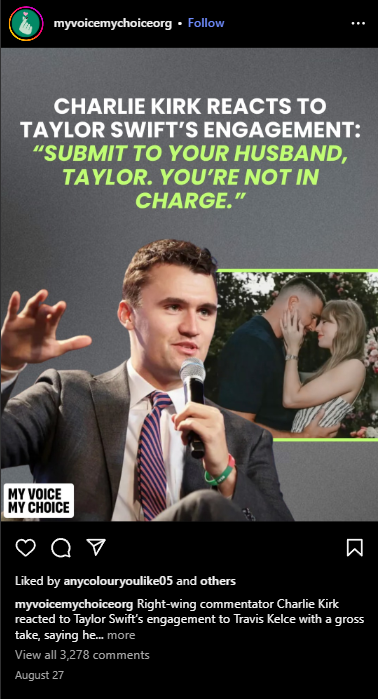
The beginning of this video shows a compilation of some of his most inflammatory content, that all would have been common representations in my feed.
But there are more sides to Charlie…
Charlie, the Christian
Many people remember Charlie as a Christian, first.

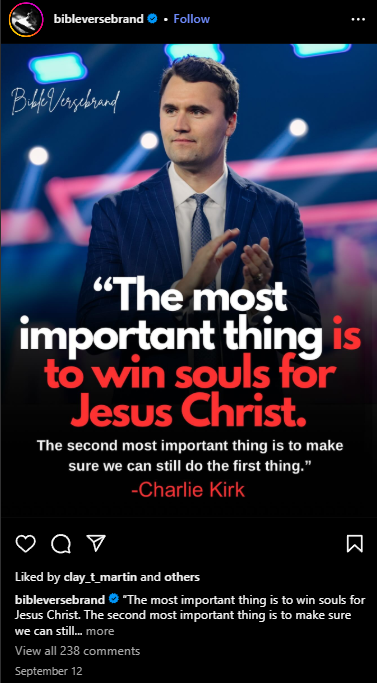
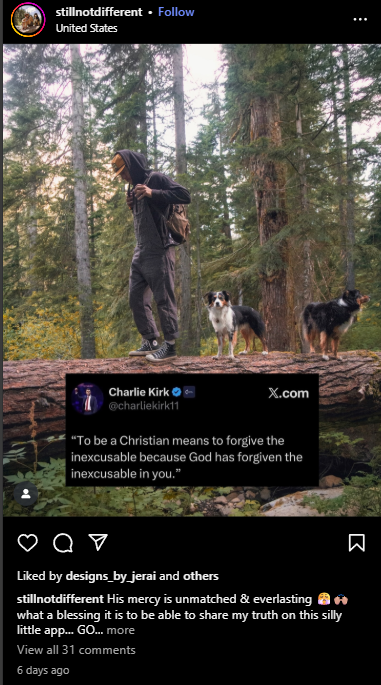
While I didn’t make any calculations, my impression was that the largest share of his content was related to Christianity. But like people of most faiths and belief systems, he believed in protecting the vulnerable.
Charlie, the protector of children
While Charlie’s interest in protecting children was often accompanied by anti-immigrant, racist, or anti-LGBTQIA sentiments, not every social media post revealed those aspects of his ideology.
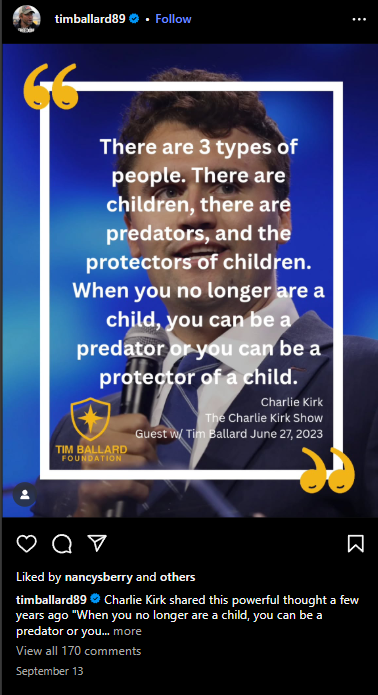
Perhaps this was an oversimplified take, but on the surface one that would resonate with many people.
Charlie, the Homeschooling Advocate
Homeschoolers come from a wide variety of political and cultural backgrounds and their reasons for homeschooling are diverse. Posts like these could be appealing to those across the political spectrum.
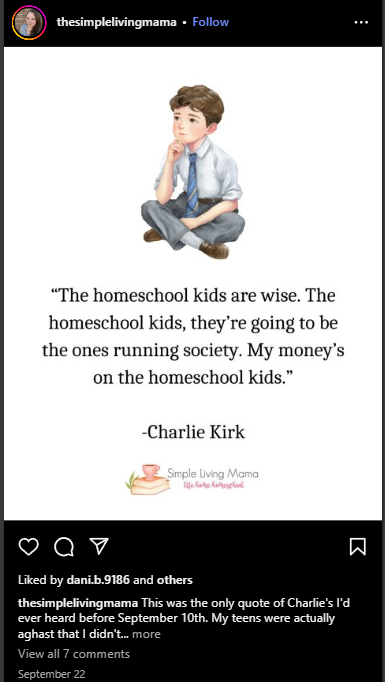
Perhaps the most relatable aspect of Charlie was his devotion to his family.
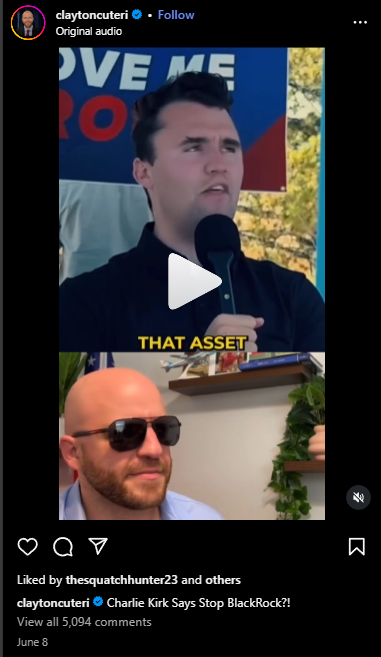
Charlie, the Populist
In the following video, Charlie is asked what should be done about the housing crisis in America. Kirk responds that we should “make it illegal that asset managers over 500 billion dollars can’t buy single family homes.” This type of policy is supported by some Democrats, and by Democratic Socialist, Bernie Sanders.
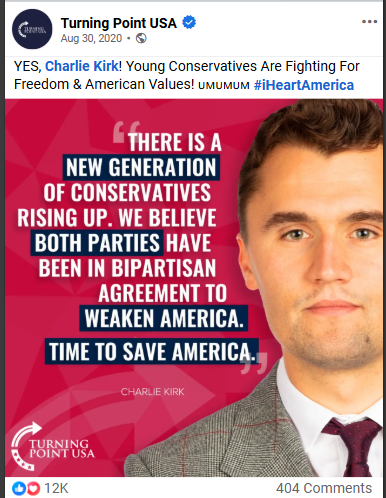
Charlie, the Independent
While Kirk overwhelmingly supported Republican candidates, the belief that both parties are responsible for problems is a popular sentiment in the U.S.
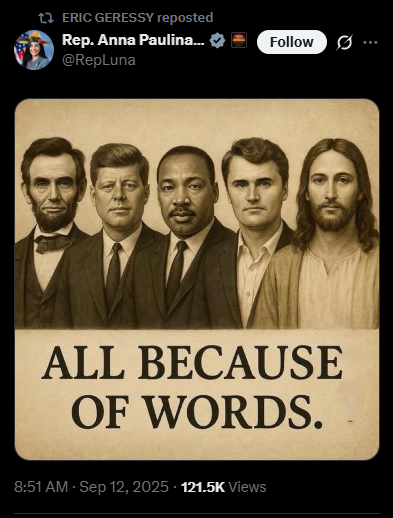
Charlie, the Free Speech Advocate
While I might not include him in this particular lineup, Kirk sometimes expressed himself as an advocate of free speech, and framing Kirk along with such notable figures sends a powerful message.
Charlie, the Husband and Father
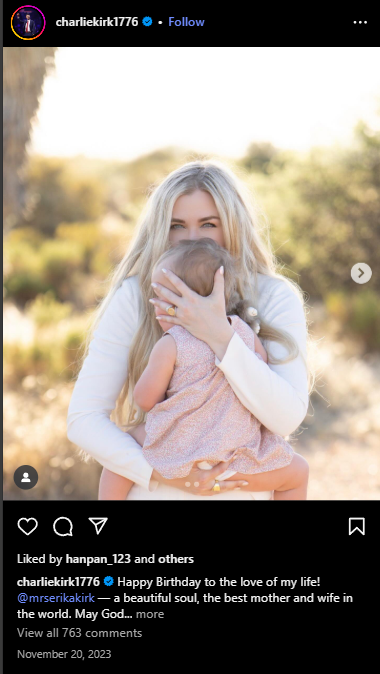
Charlie gushed about his wife, with sentiments most women would appreciate.
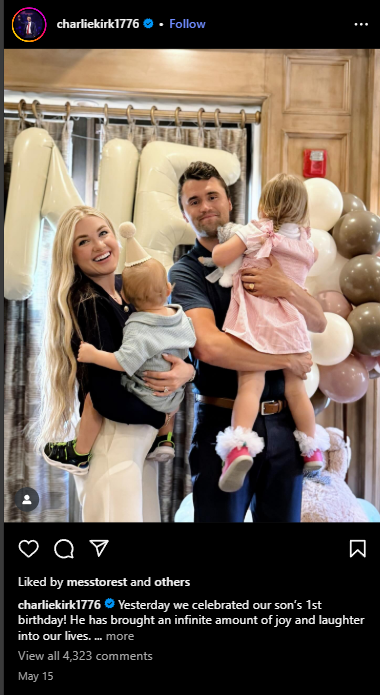
He did normal family stuff:
Despite all the content that portrayed Charlie favorably, there is ample evidence that he held great contempt for a large portion of the population. It seemed he believed that some were worthy and others were not.
Charlie, the Racist
In one of the most viral videos making the rounds after his death, Kirk says
“If we would have said that Joy Reid and Michelle Obama and Sheila Jackson Lee and Ketanji Brown Jackson were affirmative action picks, we would have been called racists. Now they’re coming out and they’re saying it for us … You do not have the brain processing power to otherwise be taken really seriously. You had to go steal a white person’s slot to go be taken somewhat seriously.”
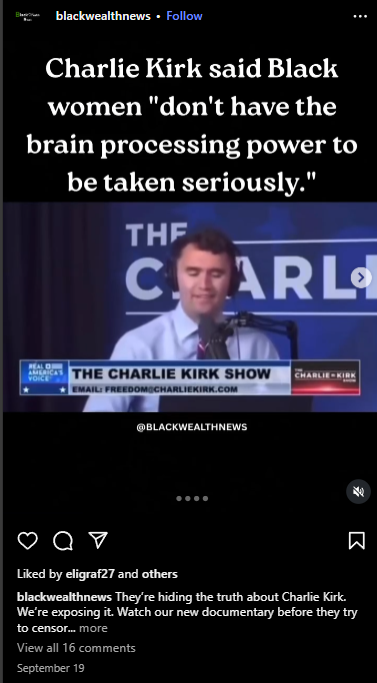
While a lot of commentary focuses on the concept of affirmative action, and claims Charlie is not talking about all black women, I believe that argument is disingenuous. The most telling part of this clip is when he refers to a “white person’s slot.” If his argument is that affirmative action isn’t fair because it gives an unfair advantage to some people over others, then the “slot” would have no ownership. His argument seems to be that access should be given by default to white people.
He argues that black men should be arrested more:
“By age 23, about half of all black males have been arrested and not enough of them have been arrested.”
He accuses black people in urban areas of targeting white people for fun.
“Happening all the time in urban America, prowling Blacks go around for fun to go target white people, that’s a fact. It’s happening more and more.”
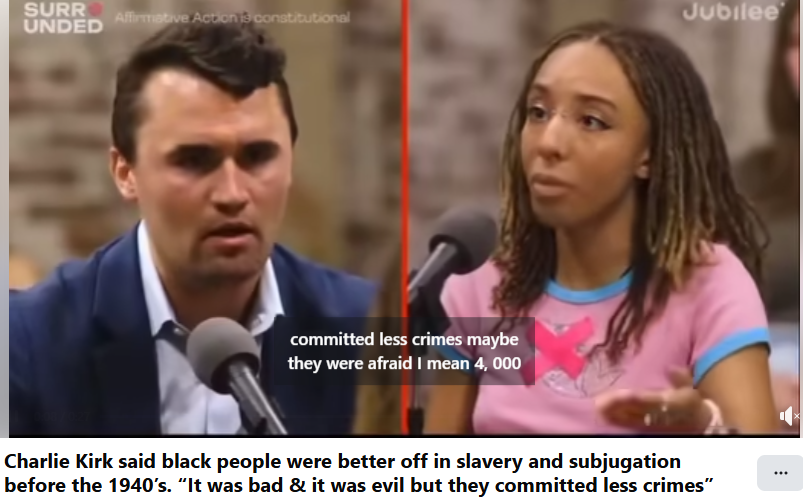
He suggested black people were “better off” in slavery and subjugation.
Anti-LGBT Charlie
Charlie was especially harsh on trans people, accusing them of being child groomers, and often described a “trans agenda.”
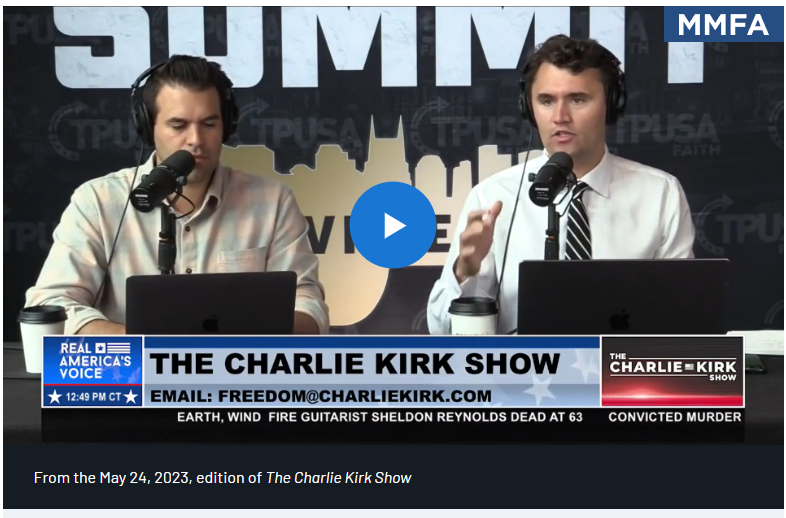
Despite the number of distinguished trans service members already serving in the U.S. military, Charlie unequivocally said that they should not be serving at all.
He accused gay people of being groomers, joining school boards to recruit children.
Anti-Immigrant Charlie
He stereotyped immigrants from certain places as being “lawless,” and accused them of trying to “destroy Western civilization.”
Charlie Kirk took aim at many others, including Muslims and the homeless. He excused and minimized political violence, equating it with street crime.
Algorithms and Reality
One of the problems with algorithms is that they are so sophisticated they essentially put us in our own reality. They are optimized for engagement, giving us more of whatever content we engage with. Research has found that algorithms interfere with natural social processes and the way we learn from each other. If we don’t recognize that, we can mistakenly believe that the people around us have all the same information as we do, and when they react differently than us, assume it is some kind of flaw in their character. Furthermore, we are not all as “online” as others, and are not analyzing every bit of media critically. Even the most media-literate people are incapable of critically analyzing the massive amount of media messages they encounter. We are all subject to different biases and different cultural lenses.
One notable thing that Charlie Kirk once said is, “You do not get to determine your own reality.” However, that is exactly what is wrong with social media algorithms, we are passively creating our own reality with no awareness of what others are seeing in theirs, and making assumptions about each other without even interacting. The algorithmic bias amplifies ragebait, engagement and vitriol, leaving little room for nuance and understanding.
Furthermore, our collective digital reality is constantly changing. Within minutes of Charlie’s death the internet was flooded with new content. It’s almost impossible to truly understand the breadth of his public perception at this point. In fact, many people did not know of him until he died.
Researchers argue that mandating algorithmic transparency and accountability is one of the most promising ways to expose how content is curated and help users better understand its influence. I agree that we need much more regulation when it comes to everything with technology, but I also think we have tools within our control right now to minimize the harm, and try to find common ground with each other at a time when that feels impossible.
Let’s Talk
Journalist Ezra Klein drew huge backlash from political allies for his editorial after Kirk’s death, saying, “Kirk was practicing politics in exactly the right way.” If you only saw that single line, and were a member of one of the many groups of people that Kirk targeted, that could come off as pretty offensive. We can add nuance though if we include a larger portion of his column.
“You can dislike much of what Kirk believed and the following statement is still true: Kirk was practicing politics in exactly the right way. He was showing up to campuses and talking with anyone who would talk to him. He was one of the era’s most effective practitioners of persuasion. When the left thought its hold on the hearts and minds of college students was nearly absolute, Kirk showed up again and again to break it.”
He elaborates:
“Kirk and I were on different sides of most political arguments. We were on the same side on the continued possibility of American politics. It is supposed to be an argument, not a war; it is supposed to be won with words, not ended through bullets. I wanted Kirk to be safe for his sake, but I also wanted him to be safe for mine, and for the sake of our larger shared project. The same is true for Shapiro, for Hoffman, for Hortman, for Thompson, for Trump, for Pelosi, for Whitmer. We are all safe, or none of us are.”
I don’t agree with Ezra’s entire take. I think Charlie often argued in bad faith using rhetorical tricks, logical fallacies, and did it against largely inexperienced opponents. His content was often spread as out-of-context clips where he appeared to “win.” But I do agree with both on one point. We must talk to each other. But I think we should do so non-violently, without memes, hyperbole and vitriol. And in person, when possible.
After consuming a significant amount of Charlie Kirk content, I have not changed my mind much about him. I don’t believe he was evil, but I believe he said hateful and harmful things that go against my core values, and I think he will cause harm to many of the people he recruited. But like the vast majority of people, I don’t think he should have died for what he said. I also don’t think his life mattered more than any of the people who die from gun violence each year, and I find it terrifying that his death is being used to intimidate and punish people, violating their constitutional rights. I think if someone like Ezra Klein had been assassinated, and Charlie Kirk was still here, he would agree.
So much political rhetoric is dehumanizing, and the divisiveness has reached a fever pitch. I wonder if the easiest way for us to re-humanize our political opponents and see each other clearly is by starting conversations with the people we know in real life…even if, or maybe especially if, it’s on Facebook.