Uncles really can’t catch a break. They have basically become the Karens of misinformation. It does seem a little unfair, since I don’t think they have a monopoly on succumbing to fake news but the Melbourne Center for Behaviour Change at the University of Melbourne has cleverly leveraged the trope to create an educational game called Cranky Uncle.
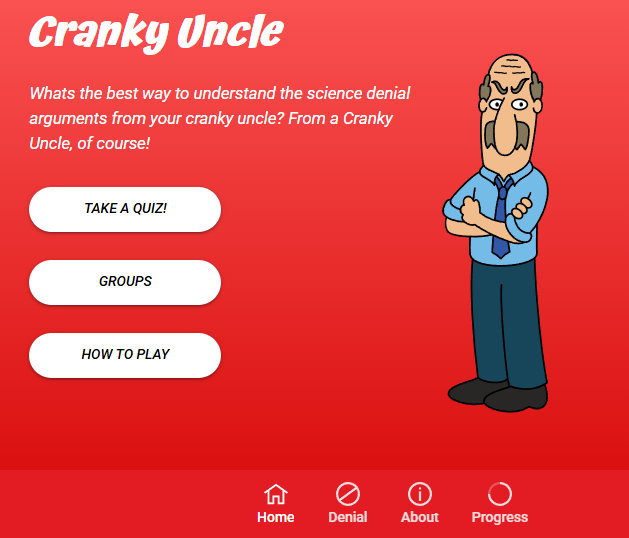
The game uses a strategy called inoculation, which teaches players to recognize the strategies used to manipulate and mislead media users. As a media literacy advocate, I found this to be an amusing and educational way to learn the basic concepts of science denial, conspiracy thinking, and the broader misinformation tactics they rely on.
Researchers have found that inoculation theory, a strategy sometimes called “prebunking,” is often more effective than debunking or fact-checking. Once a person is exposed to and buys into misinformation it is hard to get them to change their beliefs, but preparing users to encounter misinformation by revealing rhetorical strategies and logical fallacies primes them to apply more critical analysis in the future.
In Cranky Uncle, the smarter you get, the crankier he gets. With each technique that you learn, you gain points and progress through levels. At the first level you’ll learn some basic strategies of misinformation, or the FLICC Framework: Fake Experts, Logical Fallacies, Impossible Expectations, Cherry Picking and Conspiracy Theories. The game does a great job of explaining concepts in easy to understand terms, for the most part, and it quizzes you along the way to test your knowledge.
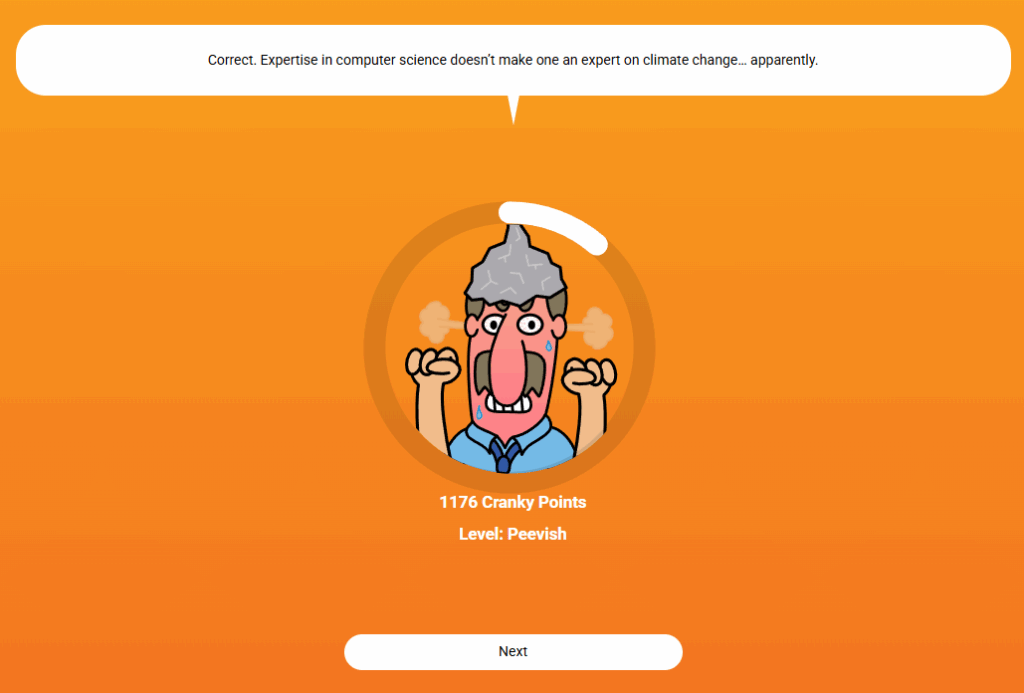
Fake Experts is a topic I find particularly salient right now, as Americans have become increasingly skeptical of expertise in general and of climate change, in particular. Health misinformation is of particular interest to me, as someone who has succumbed to it in the past. In 2025, White House Cabinet members with no expertise in Public Health have been put in charge of our institutions, making scientifically questionable claims that can cause real harm. Sowing seeds of doubt about vaccinations for example, can have an adverse effect on everyone. These claims rely on discrediting the scientific consensus of experts, with tactics like cherry picking, a strategy that presents a single study or example, while disregarding the entire body of research.
The lessons on conspiracy theories were particularly prescient. While conspiracy theories have always been around, in 2020 they really came to the forefront and threatened the U.S. democracy, as claims about the presidential election led to violent protests including the insurrection on January 6th. At the same time, conspiracy theories about the COVID-19 vaccine would lead to unnecessary deaths in the U.S. and Abroad.
Overall I found the game to be engaging and educational without being preachy. Although I did find some sections weren’t as clear as others. Logical fallacies is one of my favorite topics. But some of the quiz questions were confusing, and didn’t provide great examples of the various logical fallacies. While the game uses some silly examples of these misinformation techniques, it also uses hot button topics like climate change and COVID-19. For users starting from a basis of some skepticism on those topics, that might turn them off before they get a chance to learn something. However, I believe that most users will gain a lot of basic knowledge on misinformation strategies that empower their critical thinking abilities, and hopefully even some cranky uncles will learn something too.